

Yahoo Finance no longer offers an official API. Its paid plans, from $7.95 to $39.95 a month on yearly billing in November 2026, add features on the website such as CSV downloads in the Gold plan, and yfinance, the popular Python library, is an unofficial client for the site. A Yahoo Finance alternative with a documented API gives you published rate limits, an API key and a support contact instead.
This guide compares five financial data APIs on what matters most when you leave Yahoo Finance: the free tier, the first paid plan and how pricing is structured. All prices and limits come from each provider’s pricing page on November 11, 2026. It also shows that for the daily prices of a large US stock, the data itself matched: AAPL’s closes from EODHD and from yfinance were identical on all 11 trading days tested.
Quick jump:
- 1 What Yahoo Finance offers today
- 2 yfinance: free, unofficial, and still widely used
- 3 The same ticker from EODHD and yfinance
- 4 How to get your EODHD API key
- 5 Yahoo Finance alternatives compared
- 6 How each Yahoo Finance alternative differs
- 7 How to choose a Yahoo Finance alternative
- 8 Where this comparison breaks
- 9 Conclusion
- 10 FAQs
What Yahoo Finance offers today
Yahoo Finance’s paid plans add features to the website, according to its plans page on November 11, 2026. The page lists the yearly price as 20% off monthly billing:
| Plan | Price on yearly billing | Notes from the plans page |
|---|---|---|
| Bronze | $7.95/month, billed $95.40 a year | |
| Silver | $19.95/month, billed $239.40 a year | |
| Gold | $39.95/month, billed $479.40 a year | Download historical data as CSV, about 40 years of financial statements |
None of the plans mentions API access. Yahoo shut down its official finance API in 2017, so programmatic access today goes through unofficial libraries.
yfinance: free, unofficial, and still widely used
yfinance is an open-source Python library that reads data from the endpoints behind the Yahoo Finance website. It’s free and takes one pip install, which is why many projects start with it.
It isn’t an API product, though. The library isn’t affiliated with Yahoo, there’s no API key, no published rate limit and no service agreement, and its project describes it as intended for research and educational use. When Yahoo changes its website, the library has to catch up, so requests can fail until a new release is out.
For a personal notebook, that trade-off is often fine. For an application that other people depend on, a documented API with stated limits is the safer base.
The same ticker from EODHD and yfinance
A quick way to compare sources is to pull the same ticker from both. This script downloads AAPL’s daily prices from the EODHD end-of-day API and from yfinance, and compares the raw and adjusted closes:
import os
import sys

import pandas as pd
import requests
import yfinance as yf

API_KEY = os.environ.get("EODHD_API_KEY", "demo")

ticker, start, end = sys.argv[1:4]
url = f"https://eodhd.com/api/eod/{ticker}"
params = {"api_token": API_KEY, "fmt": "json", "from": start, "to": end}
eodhd = pd.DataFrame(requests.get(url, params=params, timeout=60).json()).set_index("date")
eodhd.index = pd.to_datetime(eodhd.index)

# yfinance uses Yahoo symbols (AAPL, not AAPL.US); its end date is exclusive
yahoo = yf.download(ticker.split(".")[0], start=start, end=pd.Timestamp(end) + pd.Timedelta(days=1),
                    auto_adjust=False, progress=False)
yahoo.columns = yahoo.columns.get_level_values(0)
yahoo.index = yahoo.index.tz_localize(None)

both = pd.DataFrame({
    "eodhd_close": eodhd["close"], "yahoo_close": yahoo["Close"].round(4),
    "eodhd_adjusted": eodhd["adjusted_close"], "yahoo_adj_close": yahoo["Adj Close"].round(4),
})
print(both.to_string())
print(f"\nLargest close difference: {(both['eodhd_close'] - both['yahoo_close']).abs().max():.4f}")
print(f"Largest adjusted close difference: {(both['eodhd_adjusted'] - both['yahoo_adj_close']).abs().max():.4f}")
Run with python same_ticker.py AAPL.US 2026-10-27 2026-11-10, the EODHD demo key and yfinance 1.8.0, as of November 11, 2026:
            eodhd_close  yahoo_close  eodhd_adjusted  yahoo_adj_close
2026-10-27       347.10       347.10          347.10           347.10
2026-10-28       343.83       343.83          343.83           343.83
2026-10-29       348.91       348.91          348.91           348.91
2026-10-30       344.63       344.63          344.63           344.63
2026-11-02       338.32       338.32          338.32           338.32
2026-11-03       331.90       331.90          331.90           331.90
2026-11-04       349.51       349.51          349.51           349.51
2026-11-05       344.17       344.17          344.17           344.17
2026-11-06       342.37       342.37          342.37           342.37
2026-11-09       350.69       350.69          350.69           350.69
2026-11-10       348.51       348.51          348.51           348.51

Largest close difference: 0.0000
Largest adjusted close difference: 0.0000
The prices were the same on every day. Two details make the comparison work: yfinance uses Yahoo’s symbols (AAPL) while EODHD adds the exchange (AAPL.US), and yfinance returns a timezone-aware index, which needs to be removed before joining. As of November 11, 2026, no dividend had gone ex after the first day of this window, so the adjusted closes equal the closes. Apple went ex-dividend on November 12, 2026, so a rerun now returns slightly lower adjusted closes for these days, while the closes stay the same. Over longer periods, adjusted prices can differ between sources, so check them on your own tickers and dates.
So in this test on one large US stock, the daily price wasn’t the difference. What a documented API adds is the contract around the data: an API key, published limits, plans that state what’s included, and data types beyond prices.
How to get your EODHD API key
1. Use the “demo” API key to test our data from a limited set of tickers without registering:
AAPL.US | TSLA.US | VTI.US | AMZN.US | BTC-USD | EUR-USD
Real-Time Data and all of the APIs (except Bulk) are included without API calls limitations with these tickers and the demo key.
2. Register to get your free API key (limited to 20 API calls per day) with access to:
End-Of-Day Historical Data with only the past year for any ticker, and the List of tickers per Exchange.
3. To unlock your API key, we recommend to choose the subscription plan which covers your needs.
The comparison above uses AAPL.US, so it runs with the demo key.
Yahoo Finance alternatives compared
For each Yahoo Finance alternative, the figures come from the provider’s pricing page on November 11, 2026. Free tiers are measured in different units, per minute or per day, so compare them against how your project actually makes calls.
| Provider | Free tier | First paid plan | Pricing notes |
|---|---|---|---|
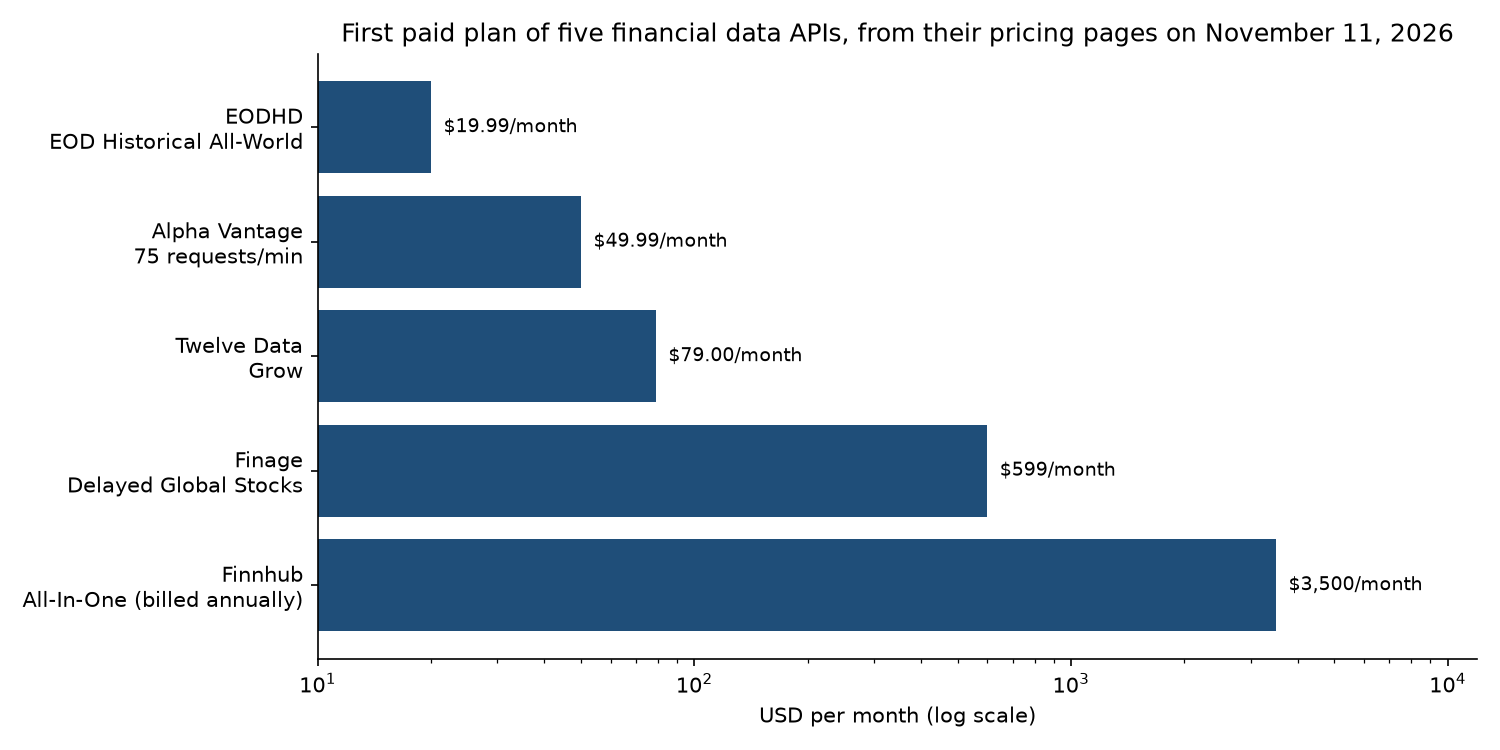
| EODHD | 20 API calls per day, 1 year of end-of-day history | EOD Historical All-World, $19.99/month (includes 15-minute delayed live data) | All-In-One $99.99/month. Fundamentals and intraday data are separate plans or All-In-One |
| Finnhub | 60 API calls per minute, US coverage, personal use | All-In-One, $3,500/month, billed annually | The free and All-In-One plans are the two shown on the pricing page |
| Twelve Data | 800 API requests per day | Grow, $79/month billed monthly | Separate personal and commercial pricing. Some exchanges are yearly add-ons |
| Alpha Vantage | 25 API requests per day | 75 requests per minute, $49.99/month | Realtime and 15-minute delayed US data are premium-only |
| Finage | No free plan, 3-day free trial | Delayed Global Stocks Data, from $599/month | Global plans are priced for one country |
How each Yahoo Finance alternative differs
EODHD covers end-of-day prices for global exchanges, fundamentals, intraday and real-time data, technical indicators, news and more, with each data type in a defined plan. The free plan is enough to test the API on one year of daily data, and the demo key covers a set of tickers, including AAPL, TSLA and AMZN, with all APIs except Bulk. There are also add-ons for Excel and Google Sheets, which suit users who used to download CSV files from Yahoo Finance. Thirty years or more of daily history starts with the EOD Historical All-World plan.
Finnhub’s free tier is the only one here quoted per minute: 60 calls per minute, for US data and personal use. Its pricing page lists the free plan and an All-In-One plan at $3,500 a month, which adds global coverage, deep fundamentals and estimates history.
Twelve Data has a free Basic plan with 800 requests a day and paid plans from $79 a month. It prices personal and commercial use separately, and some exchanges, such as the ASX or Cboe Europe, are sold as yearly add-ons, so the total depends on the markets you need.
Alpha Vantage’s free tier covers the majority of its datasets, according to its support page, with 25 requests a day. Premium plans are priced by requests per minute, from 75 requests per minute at $49.99 a month, and are required for realtime and 15-minute delayed US market data.
Finage has no free plan and offers a 3-day trial. Its plans start at $599 a month for delayed global stock data, and its global plans are priced for one country.
How to choose a Yahoo Finance alternative
A few questions narrow down the right Yahoo Finance alternative quickly:
- Which markets do you need? If your project covers more than US stocks, check coverage first, and whether international exchanges are included or sold separately.
- Which data types? Daily prices are widely available. Fundamentals, intraday bars, options, news and technical indicators vary much more between providers and plans.
- How many calls, and how fast? A free tier of 20 or 25 calls a day suits testing. A screener or a backtest over many tickers needs a paid plan, so compare the plans at the volume you expect.
- Personal or commercial use? Several providers price commercial use or redistribution separately. Read the license before building a product on any of them.
- How do you want to access the data? Beyond a REST API, check for an official Python library, spreadsheet add-ons, WebSockets for real-time data, or an MCP server for AI assistants.
Where this comparison breaks
Pricing pages change often, and this comparison reflects them on November 11, 2026. Check the current page before you decide. Free tiers also differ in what they include, not only in their limits, so the cheapest plan on paper may not cover the data your project needs. And a plan’s price is only part of the cost: the time spent working around missing data, rate limits or an unofficial client can matter more than the subscription.
Conclusion
Yahoo Finance is still useful on the web, but it has no official API, and yfinance is an unofficial client. In this test, AAPL’s daily prices from yfinance and from EODHD APIs matched exactly, so the reasons to move to a documented API are the contract, the limits you can plan around and the data types beyond prices.
Among the five Yahoo Finance alternatives compared, free tiers ranged from 20 calls a day to 60 calls a minute, and first paid plans from $19.99 to $3,500 a month. EODHD combines a free plan for testing, a demo key with all APIs for a set of tickers, and paid plans from $19.99 a month that cover global end-of-day data with 15-minute delayed live prices, with intraday data and fundamentals in higher plans.
For plan details, see the EODHD pricing page and the End-of-Day Historical Data API documentation.
FAQs
Q: Does Yahoo Finance still have an API?
No. Yahoo shut down its official finance API in 2017. Libraries such as yfinance read data from the Yahoo Finance website, but they aren’t official and have no published rate limits or support.
Q: What is the best free alternative to Yahoo Finance?
It depends on how you use the data. In November 2026, Finnhub’s free tier allowed 60 calls per minute for US data, Twelve Data’s 800 requests per day, Alpha Vantage’s 25 requests per day, and EODHD APIs offered 20 calls per day with one year of history. The EODHD APIs demo key also covers a set of tickers with all APIs except Bulk.
Q: Is yfinance data accurate?
In this test, AAPL’s daily closes from yfinance matched those from EODHD APIs on all 11 trading days. That’s one ticker over a short window, so test your own tickers and dates. The bigger risk with yfinance is access: requests can break when Yahoo changes its website.
Q: Is Yahoo Finance Gold worth it for data downloads?
Gold costs $39.95 a month on yearly billing and includes CSV downloads of historical data on the website. If you need the data in code, an API with a documented key and limits is usually the better fit. In this comparison, the EODHD EOD Historical All-World plan starts below that price, at $19.99 a month.
Q: Can I use these APIs for a commercial product?
Check each provider’s license before you build a product on its data. Terms for commercial use and redistribution differ from one provider to another.